
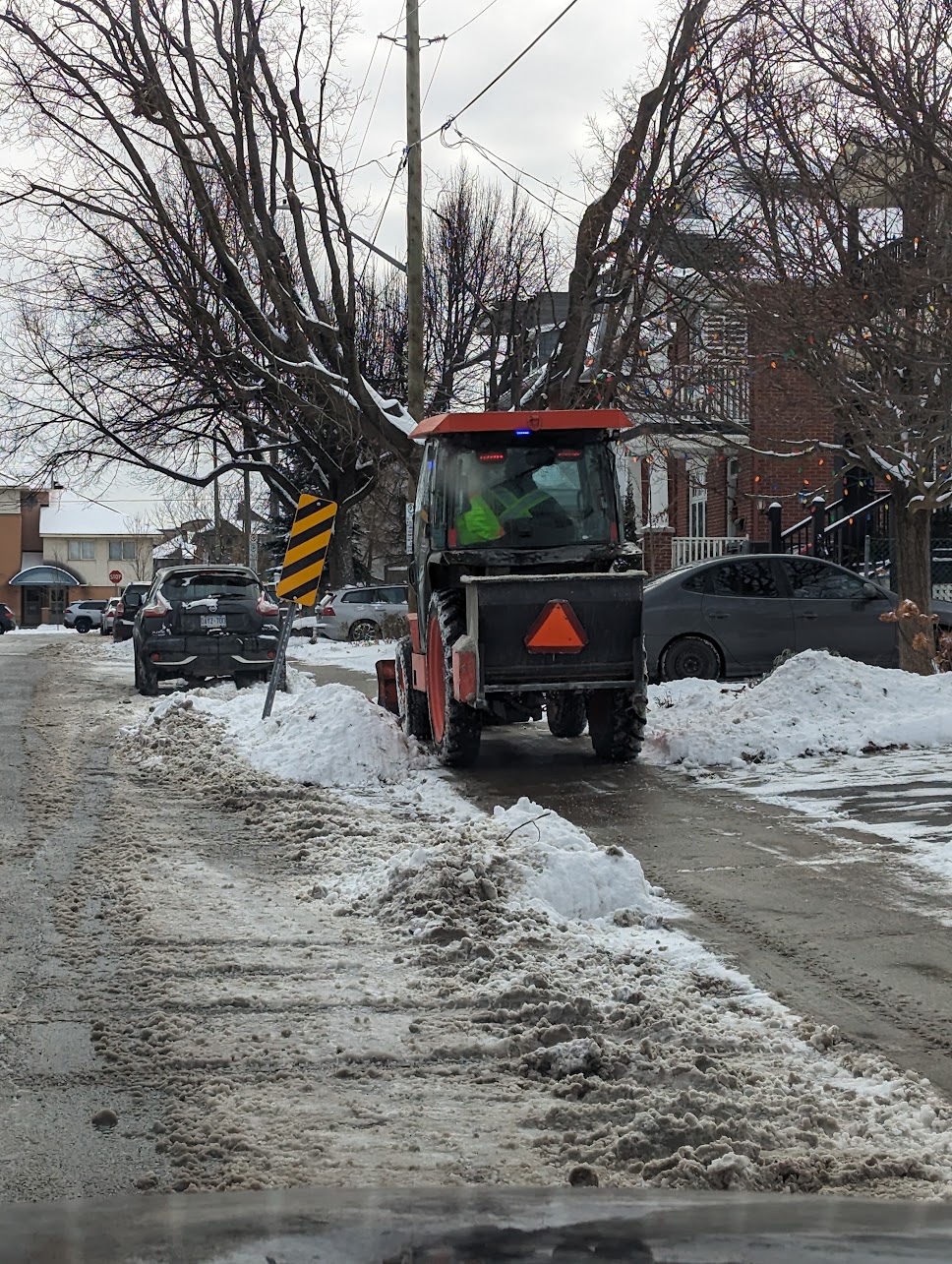
The landlord is responsible, by default, under Ontario law. Snow removal and lawn care are part of the maintenance duty section 20(1) of the Residential Tenancies Act, 2006 places on the landlord, and a lease clause handing that work to the tenant does not move the duty.
This question lands on our desk every fall, usually attached to a lease copied from another province or a template bought online. The tenant shovelled for two winters without complaint, then reads the Act, or slips, or simply stops. At that point the clause is all the landlord is holding, and it is worth less than either side assumed.
In Ontario, the shovel belongs to the landlord. A lease cannot hand it to the tenant; only a separate, paid agreement can, and the legal duty stays with the landlord either way.
What does Ontario law say the landlord must maintain?
The duty starts with section 20(1) of the Residential Tenancies Act, 2006: a landlord is responsible for providing and maintaining the residential complex, including the rental units in it, in a good state of repair and fit for habitation, and for complying with health, safety, housing and maintenance standards. Section 20(2) adds that the duty applies even if the tenant knew the property’s state before signing. The Board’s brochure, Maintenance and Repairs, puts it the same way: the obligations apply to every rental agreement, even where the agreement says something different.
The standards underneath section 20 name the outdoor work directly. Ontario Regulation 517/06, the provincial Maintenance Standards, requires exterior common areas to be kept free of hazards, including “unsafe accumulations of ice and snow” (section 26(1)), and requires driveways, paths, walkways, landings and outside stairs to be kept as a safe surface (section 28). CLEO’s Steps to Justice guide names the seasonal tasks plainly: the landlord must do yard work like cutting the lawn, and shovel snow and keep ice off driveways and sidewalks.
The tenant’s own duty is much narrower. Section 33 makes the tenant responsible for the ordinary cleanliness of the rental unit; cleanliness inside the unit is not maintenance of the property outside it. Our guide to Ontario landlord rights and responsibilities works through the full set of duties section 20 creates; snow and lawn sit in the same category as heating and pest control, not in a seasonal exception.
Why doesn’t a lease clause make it the tenant’s job?
Because section 4(1) provides that a provision in a tenancy agreement that is inconsistent with the Act or the regulations is void. A clause assigning the landlord’s maintenance work to the tenant is inconsistent with section 20, so it fails however clearly it is written or willingly it was signed.
The leading case is Montgomery v. Van, 2009 ONCA 808. The tenant rented a basement apartment, and her lease said: “Tenants are responsible for keeping their walkway and stairway clean (including snow removal).” She slipped on ice on the walkway, was injured, and sued. The Ontario Court of Appeal held the provision void under the void-for-inconsistency rule in the Act then in force, the same rule the current Act carries in section 4. Board decisions apply the same reasoning: the clause cannot be enforced, the tenant cannot be evicted for refusing the work, and a monthly snow or lawn fee collects for a duty the Act assigns to the landlord, running into section 134’s ban on additional charges the Act does not permit.
Habit changes none of this. A tenant who cleared the steps for three winters out of goodwill, or because the clause said to, has not amended the Act. The first winter they stop, the duty is where it always was.
What is a separate services agreement, and what must it contain?
There is one arrangement that works, and Montgomery v. Van is also the source for it. The Court of Appeal accepted that a landlord can hire the tenant as a service provider, provided the promise to do the work is a contractual obligation that stands on its own, severable from the tenancy agreement. CLEO’s guide says the same in practical terms: the landlord can pay the tenant, or give something else of value, for maintenance work, as long as the work and the return are both clear.
Severable is the whole ballgame. Paper stapled to the lease, buried in the standard form’s additional terms, or signed because the tenancy depended on it invites the same voidness argument as the clause it replaces. Paper that reads as a small services contract, priced and dated like one, is what adjudicators enforce. It should carry all of the following:
| Element | What to write down, and why |
|---|---|
| A separate document | Signed on its own, not as a lease schedule or a standard-form additional term. Separateness is what makes it severable under Montgomery v. Van. |
| The work, itemized | Which surfaces and tasks: driveway, front steps, walkway, the plow windrow, salting, lawn cutting and edging. Vague words like “yard maintenance” produce February arguments. |
| The season and the trigger | Start and end dates, when clearing happens (for example, after each snowfall ends, and again after the city plow passes), and how often the lawn is cut. |
| Real consideration, stated | A set amount paid to the tenant for the work, and how and when it is paid. It must be value the tenant actually receives for the service. Get advice before structuring it as a rent credit; Ontario’s rent rules are their own subject. |
| An exit that leaves the tenancy alone | Either side can end it on stated notice. Ending it is a contract event, never a tenancy breach or a ground to end the tenancy. |
| What happens if the work stops | The landlord hires someone else and pursues any claim as a contract matter. The section 20 duty was never transferred, so the clearing still has to happen. |
That last row is the point landlords most often miss. A services agreement moves the performance of the work, not the responsibility for the standard, any more than hiring a contractor does. If your tenant-provider quits in January, the Board and the city still look to you; your remedy is a contract claim, not a defence.
What does the City of Ottawa clear, and what stays with the property?
The City of Ottawa clears its own roads, sidewalks and pathways: the City’s winter maintenance quality standards review of November 10, 2025 puts the sidewalk and pathway network at about 2,500 kilometres, cleared by city crews on a priority sequence, with residential sidewalks later in that sequence after a storm. The public sidewalk in front of your rental is the City’s job.
Everything on the property is the owner’s side of the line: the front steps, the walkway, the driveway, and the windrow, the ridge of snow the street plow leaves across the bottom of the driveway. City winter guidance is explicit that clearing the driveway windrow is the homeowner’s job, that snow and ice must not be pushed onto the street, sidewalk, path, park or right of way, and that hydrants and, at melt time, catch basins should be kept clear.
Ottawa’s by-laws set the floor the work has to meet. The Property Standards By-law, No. 2013-416, governs yards and walkways, and its definition of “owner” includes the person managing or receiving the rent, which is why a property standards order lands on the owner or manager, not the tenant. The Property Maintenance By-law, No. 2005-208, covers the exterior, including accumulations of hazards and debris. Where a municipal by-law covers the exterior, Ontario Regulation 517/06, section 4, says the city’s standards apply. Enforcement runs as the Board’s brochure describes: a complaint (in Ottawa, through 3-1-1) can bring an inspection and a work order, and if the work is not done the city can have it done and add the cost to the property taxes.
How does the answer change for a house, a plex or a condo?
The duty does not change. Who performs the work does.
| Situation | Who arranges and pays for snow and lawn | Why |
|---|---|---|
| A house rented as a whole | The landlord, including the driveway, steps and walkway only that household uses | Exclusive use of the yard does not transfer the section 20 duty; Montgomery v. Van itself involved one household’s walkway. |
| A duplex or small plex with a shared driveway or yard | The landlord | Shared outdoor areas are exterior common areas under Ontario Regulation 517/06, sections 26 and 28. |
| An apartment building | The landlord, usually through a seasonal contractor | Entrances, parking areas and walks are common areas no individual lease can be made to carry. |
| A rented condominium unit | Split: the condominium corporation for common elements; the landlord for anything the declaration leaves to the unit | Under section 90(1) of the Condominium Act, 1998 the corporation maintains the common elements; section 91 lets the declaration assign exclusive-use areas, such as some townhouse driveways and front steps, to the unit owner. Either way it is not the tenant’s job. |
The condo row produces real confusion, because the landlord’s condo fees already pay for the corporation’s grounds contract. Read the declaration before promising a tenant anything: in many Ottawa condo townhouse communities the corporation clears the roads and main walks while the driveway apron and front step sit with the unit. Your section 20 duty covers the whole route from the street to the tenant’s door, so whatever the corporation does not do is yours to arrange.
If the tenant hires someone to clear it, who pays?
The tenant does, unless you agreed otherwise in advance or the Board orders you to. No rule lets a tenant commission work on the landlord’s duty and send the landlord the invoice as of right, and Board decisions have refused reimbursement where the tenant could not document an agreement or the expense. Receipts are not bureaucracy here; they are the claim.
The sequence the Act provides runs the other way. The tenant tells the landlord about the problem, in writing. If the landlord does not act in a reasonable time, the tenant can file Form T6, a Tenant Application about Maintenance, under section 29(1). On it the Board can, under section 30(1), order a rent abatement, order the landlord to do the work by a set date, authorize work done or to be done and order the landlord to pay its cost, and order payment of the tenant’s out-of-pocket expenses. That is how a tenant’s snow bill becomes the landlord’s: through an order, not self-help. The brochure is equally plain that the tenant may not withhold rent.
Two consequences follow. If your tenant offers to arrange clearing through someone they know, confirm the amount, scope and receipt requirement in writing before the season starts, then pay promptly; an email chain is evidence, a hallway conversation is not. And reimbursing a tenant’s contractor once, casually, does not transfer the duty or create the separate agreement described above. If it will run all season, put it on the proper paper.
How do you set this up before the first big snowfall?
Ottawa’s weather makes this a fall task. Seasonal snow contracts here are typically signed in the fall, and after the first major storm the reliable contractors are booked. Our Ottawa rental winterizing checklist covers the rest of the fall list, from furnace servicing to frozen pipes; the seasonal contract belongs on the same page of your calendar.
Whatever route you choose, contractor, tenant services agreement, or your own blower, settle these points before the snow does:
- Trigger and timing. At what accumulation does clearing start, and is there a return visit after the city plow passes for the windrow? A contract silent on the windrow is a contract for a blocked driveway.
- Ice control. Freezing rain is an Ottawa specialty. Name salting or sanding of steps and walkways in the scope, with salt or sand stored on site before December.
- Where the snow goes. Onto the property, never onto the street, sidewalk or a neighbour’s lot, and piled where meltwater will not run at the foundation.
- Parking ban nights. From November 15 to April 1 the City may call a winter weather parking ban when significant snow or freezing rain is forecast. Tell tenants in the fall, in writing.
- The lawn half of the year. Spring cleanup, a first cut in May, and leaf cleanup before the snow arrives keep the property inside the city’s yard standards. One 12-month grounds agreement covering both seasons is common in Ottawa.
- Records. Keep the contract, invoices and a simple log of visits. If a fall is ever disputed, the log is the difference between a file and a memory.
Our seasonal rental maintenance checklist spreads these tasks across the whole year, so the fall conversation covers the spring too.
Can you handle the shovel yourself?
Often, yes, and the law does not care whose hands are on it. If you live in Ottawa, own one house with a short driveway, and can get there during a storm, clearing it yourself is lawful and common. Section 20 imposes a duty to get the property maintained, not a duty to hire anyone.
Self-help breaks down on logistics, not law. An out-of-town owner cannot shovel from another province, and a landlord with several doors cannot be at all of them the morning after a storm. Travel in January or an injury in February turns a saved contract fee into an uncleared property in the exact weeks when falls happen. That is where seasonal grounds work becomes a coordination problem: contracts in place before the season, someone watching the forecast, records kept with the maintenance file. Coordinating maintenance like this is core to RentSetGo Property Management’s full service property management for Ottawa landlords, and it is one of the first things we set up on a new property, in the fall, before the tenant asks who holds the shovel.
What this guide can’t tell you
It cannot tell you whether a side agreement you already have is severable. That turns on the wording and how it was signed, and it is a question for a licensed paralegal with the paper in hand. Agreements signed years ago as part of a lease package are the weakest candidates.
It cannot read your condominium’s declaration for you. Section 91 lets each declaration draw the corporation-versus-unit line differently, and townhouse declarations are where the driveway and front-step assignments hide.
And it does not decide slip-and-fall liability. A personal injury claim on an icy walkway is assessed under occupier’s liability law on its own facts, and courts applying that law have refused to let landlords shed their statutory maintenance duties through lease wording. Your insurer and, after an incident, a lawyer are the right advisors there.
The Bottom Line
Budget snow removal and lawn care as a landlord cost in every Ontario tenancy, because that is what section 20 makes them. Take the tenant-does-it clause out of your lease before a tenant or an adjudicator does it for you. If your tenant genuinely wants the work, do it properly: a separate services agreement, itemized, priced, terminable without touching the tenancy. Keep Ottawa’s line straight: the City clears its sidewalks, the property clears everything from the sidewalk in, windrow included. Arrange the season in the fall, and keep the records. Landlords rarely get into trouble because they paid for clearing; they get into trouble because they relied on a lease sentence that was never worth anything.
Frequently Asked Questions
Is snow removal the landlord’s or the tenant’s responsibility in Ontario?
The landlord’s. Section 20(1) of the Residential Tenancies Act, 2006 makes the landlord responsible for maintaining the residential complex in a good state of repair and in compliance with maintenance standards. Ontario Regulation 517/06 requires exterior common areas to be kept free of unsafe accumulations of ice and snow, and walkways and outside stairs kept as a safe surface. CLEO’s Steps to Justice names the tasks directly: the landlord does yard work like cutting the lawn, and shovels snow and keeps ice off driveways and sidewalks.
Can a lease make the tenant responsible for snow removal or lawn care?
No. Section 4(1) says a provision in a tenancy agreement that is inconsistent with the Act or the regulations is void. In Montgomery v. Van, 2009 ONCA 808, the Court of Appeal held a lease clause making the tenant responsible for snow removal void on exactly that ground. The tenant cannot be evicted for refusing the work, and years of voluntary shovelling do not change the clause’s status.
Can a landlord pay a tenant to shovel snow and cut the lawn?
Yes, under a separate services agreement. Montgomery v. Van accepts that a landlord can hire the tenant as a service provider if the promise to do the work is severable from the tenancy agreement. The tenant is paid, or receives something else of clear value, for defined work. It is a contract sitting beside the tenancy, not a term of it, so ending it does not breach or end the tenancy.
What should a separate snow removal or lawn care agreement include?
A separate signed document, an itemized list of the work (surfaces and tasks, including the plow windrow and salting), the season’s dates and clearing trigger, the amount the tenant is paid and how, a way for either side to end it on notice without affecting the tenancy, and what happens if the work stops. Even with a valid agreement, the section 20 duty stays with the landlord, so if the tenant stops mid-winter the landlord still has to get the property cleared.
Who clears the sidewalk in front of an Ottawa rental?
The City of Ottawa. The City clears its own sidewalks and pathways, about 2,500 kilometres of them, on a priority sequence. The property is responsible for everything from the sidewalk in: front steps, walkway, driveway, and the windrow the street plow leaves at the bottom of the driveway. Snow must not be pushed onto the street, sidewalk, path, park or right of way.
Who is responsible for snow removal and lawn care at a rented condo?
It is split between the condominium corporation and the landlord; it is never the tenant’s job. Under section 90(1) of the Condominium Act, 1998, the corporation maintains the common elements, usually the grounds, roads and main walks. Section 91 lets the declaration assign exclusive-use areas, such as some townhouse driveways and front steps, to the unit owner, making that slice the landlord’s to arrange. The tenant’s contact is the landlord either way.
If a tenant hires someone to clear the snow, does the landlord have to pay?
Not automatically. A tenant who commissions the work without the landlord’s agreement pays for it, and Board decisions have refused reimbursement where the tenant could not document an agreement or the expense. The Act’s route is written notice first; if the landlord does not act in a reasonable time, the tenant can file Form T6, and under section 30(1) the Board can order a rent abatement, order the work done by a date, authorize the work and order the landlord to pay its cost, and award out-of-pocket expenses. The tenant may not withhold rent over maintenance.
Facing your first Ottawa winter as a landlord?
RentSetGo Property Management sets up the seasonal work on the rentals we manage before the snow arrives: a contractor under contract for clearing and ice control, lawn and grounds work on the same annual cycle, visits and invoices logged with the property’s records, and no reliance on a lease clause that section 4 makes void. Where a tenant wants the work, we put the separate paid agreement in place instead.
Send us the property and its tenancy start date, and we will send back a seasonal services checklist for it: what to contract out, what a tenant services agreement would need to say, and what stays on your side.
613-800-2523 · info@rentsetgo.ca
BOOK A CALL GET A FREE MANAGEMENT QUOTE
Seasonal grounds work and full management for landlords across Ottawa, houses, plexes and condo units.
Related Reading
- Ontario landlord rights and responsibilities
- Winterizing your Ottawa rental: a landlord’s checklist
- Seasonal rental property maintenance checklist for Ottawa landlords
- Full service property management in Ottawa
- Residential Tenancies Act, 2006 (e-Laws)
- Landlord and Tenant Board: Maintenance and Repairs brochure
This article is general information about snow removal and lawn care responsibilities in Ontario rentals, not legal advice. It was prepared on October 25, 2026, from the Residential Tenancies Act, 2006 (e-Laws consolidation current from September 21, 2026), Ontario Regulation 517/06, the Condominium Act, 1998, Montgomery v. Van, 2009 ONCA 808, the Landlord and Tenant Board’s Maintenance and Repairs brochure, CLEO’s Steps to Justice guide, and City of Ottawa winter maintenance and by-law sources, including Property Standards By-law No. 2013-416 and Property Maintenance By-law No. 2005-208. Whether a specific services agreement is enforceable, and how a specific condominium declaration divides outdoor work, depends on documents this article has not seen. Rules and by-laws change; confirm the current versions, and consult a licensed paralegal or lawyer about a specific tenancy.