The warranty on a new Ontario home starts on the day you take possession. It doesn’t wait for you to fly in. It doesn’t wait for your first tenant to notice the kitchen drawer that sticks.
Tarion’s first warranty claim window, the Initial Form, opens on your warranty start date and closes 41 days later. For an owner living in Vancouver or overseas, that window can close before anyone has opened every cupboard in the unit.
That’s the part most out-of-town buyers miss. They hire a property manager to find a tenant and collect rent. In our experience the costly mistakes happen earlier, in the weeks between the pre-delivery inspection and the first lease, when nobody local is watching the unit.
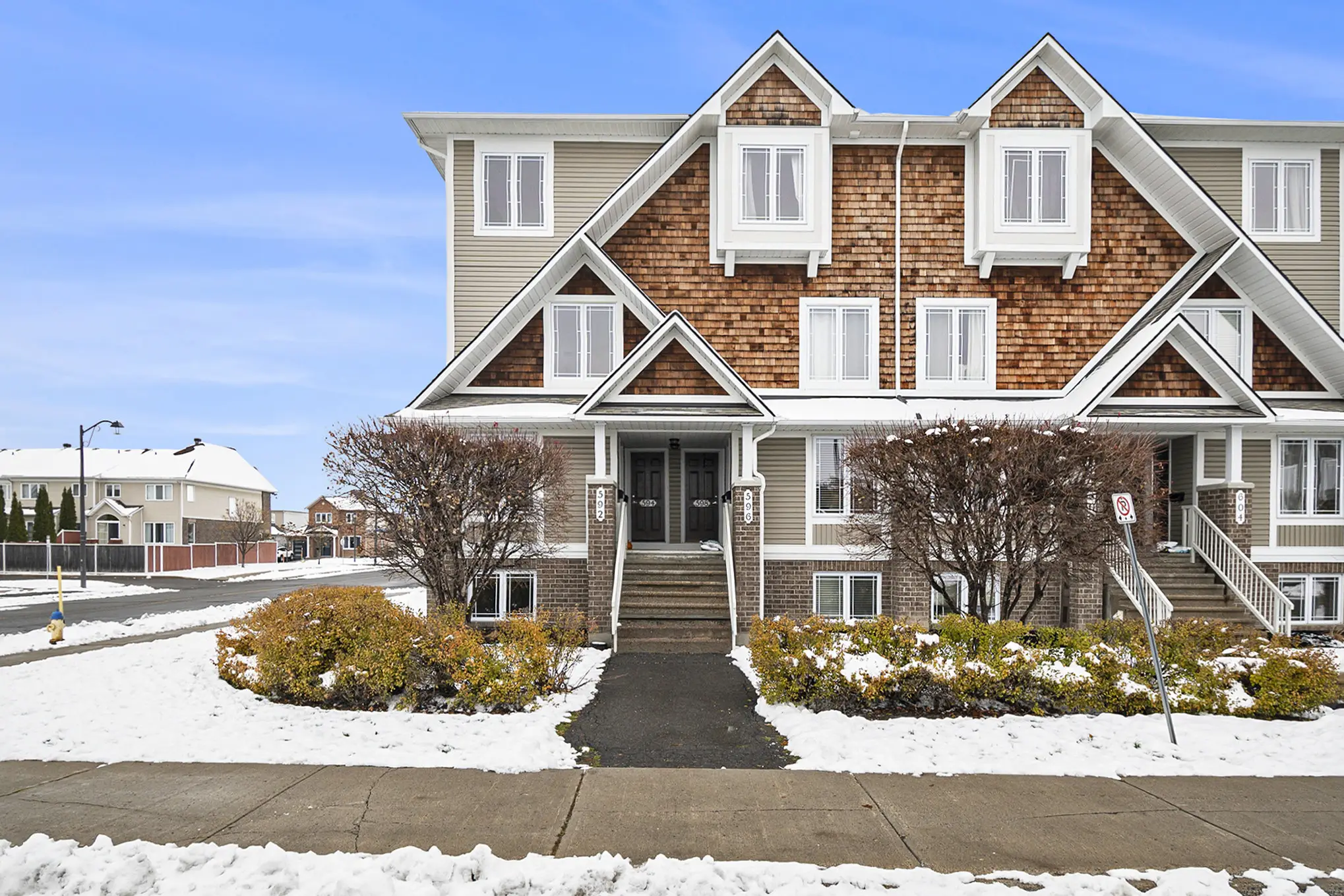
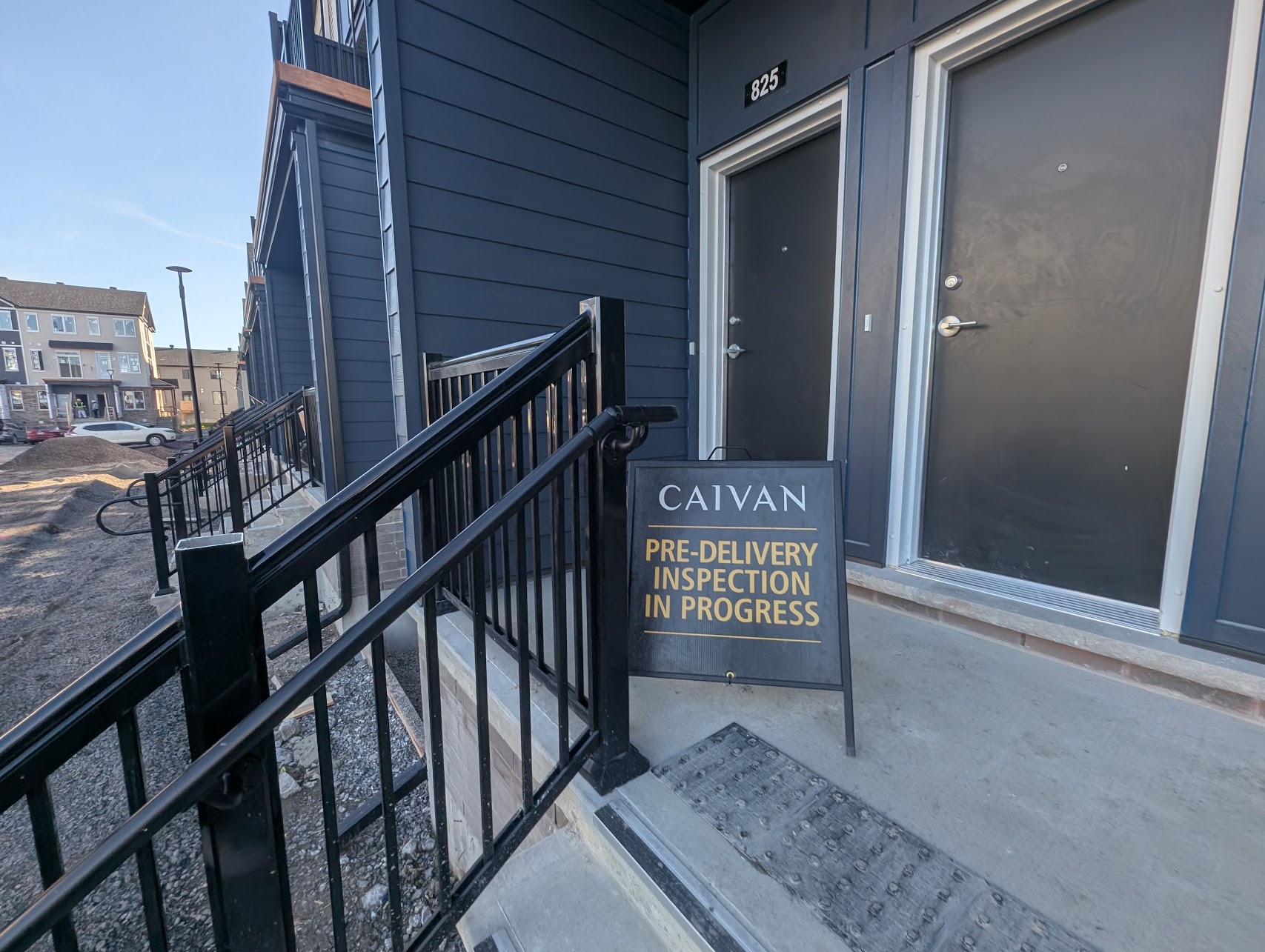
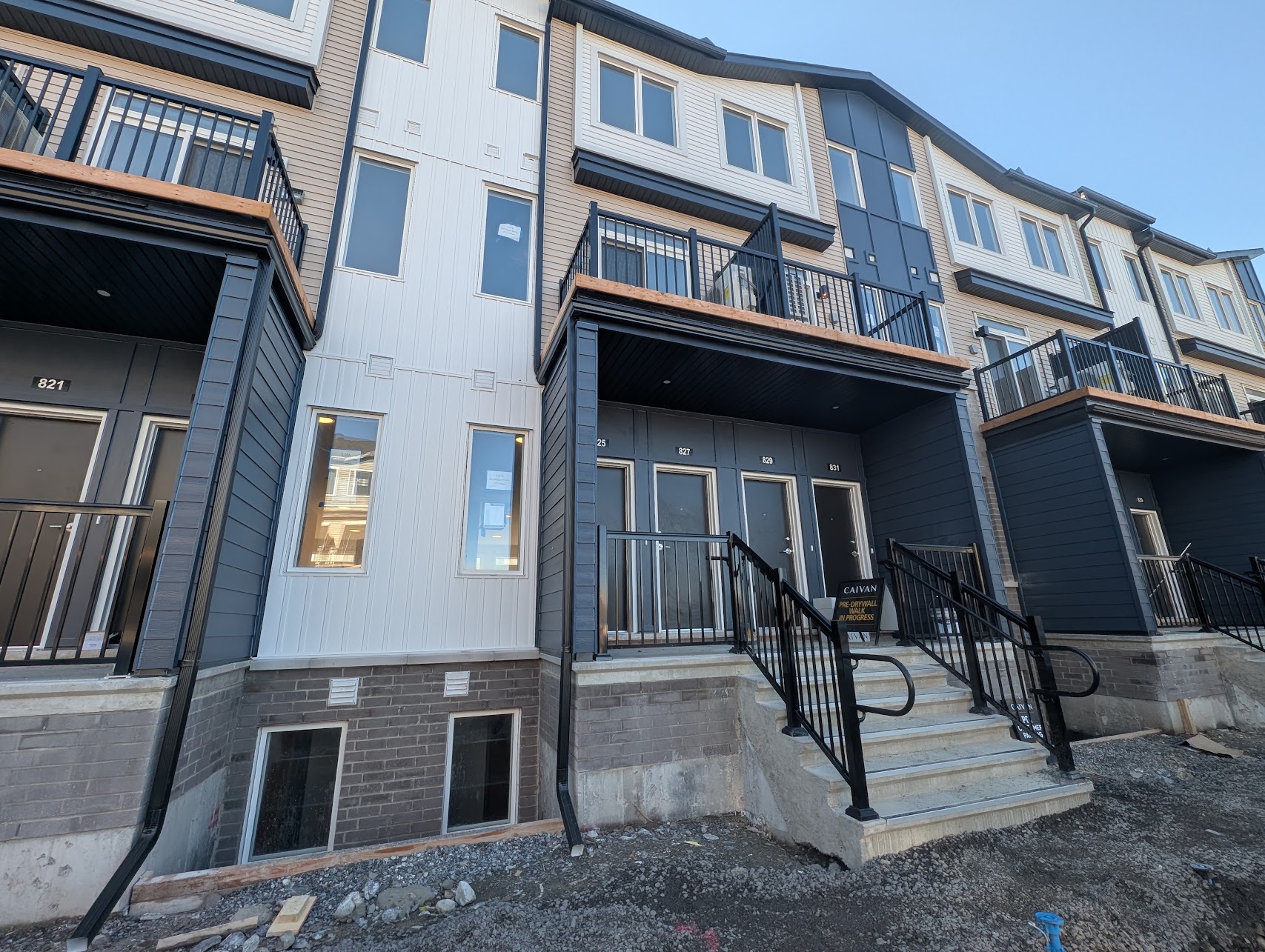
This guide walks through that stretch using the handover process at Caivan’s Orléans Village stacked townhomes as a worked example, because it’s typical of how Ottawa builders hand over a home. Builder steps differ. Your purchase agreement and closing package are what actually govern.
Why a New Build Isn’t Rent-Ready on Closing Day
Start with the uncomfortable part: you pay from day one, and the unit earns nothing until it’s leased.
Stacked townhomes in Ottawa are usually condominiums, which often means a period of interim occupancy before final closing. According to Tarion, the monthly occupancy fee during that period covers interest on the unpaid balance, estimated property taxes and projected common expenses. You pay it whether or not anyone lives in the unit, and it doesn’t reduce your purchase price.
Meanwhile, the unit itself arrives empty in ways buyers don’t expect:
- Keys come by lockbox, on the builder’s schedule. Caivan releases keys through a lockbox at the front of the home once the lawyers have completed the occupancy paperwork. Releases happen on weekdays during business hours, and the builder says plainly that the time isn’t guaranteed. Someone has to be free to wait.
- Appliances come after you close. Caivan’s appliance package is ordered through a retail partner and delivered after occupancy. The builder’s own checklist says to book delivery for the day after occupancy. Once the standard package is delivered, exchanges and returns aren’t permitted, so someone needs to inspect each appliance at the door.
- No window coverings. Blinds are rarely in a builder’s standard package. Custom blinds can take weeks to arrive after measuring.
- No mailbox key. New communities use community mailboxes, and the key has to be activated and picked up through Canada Post.
- Utilities in nobody’s name. The builder’s checklist covers Hydro Ottawa, Enbridge, a sub-metered water provider and a separate company that rents out the tankless water heater, air handler, air conditioner and energy recovery ventilator. Each account has to be opened before the tenant arrives.
A new build closes empty. Rent starts when the blinds are up, the appliances are in and the deficiencies are fixed, not when the keys are released.
The Warranty Clock Starts Without You
Your warranty start date is printed on the Certificate of Completion and Possession (CCP), the Tarion form the builder signs at handover. Caivan tells buyers to send the CCP to their lawyer before closing. Keep a copy yourself, because every warranty deadline counts from that date.
For condominium units with interim occupancy, Tarion is explicit: the warranty begins when interim occupancy begins. Not when you move in, and not when title transfers.
| Tarion form | When you can submit it | What it’s for |
|---|---|---|
| Initial Form | 1 to 41 days after the warranty start date | Outstanding PDI items plus anything new found after move-in |
| Year-End Form | Last 30 days of the first year | One-year items: work and materials, Building Code compliance |
| Second-Year Form | Any time in the second year | Water penetration, electrical, plumbing and heating systems, exterior cladding |
| Major Structural Defect Form | After year two, up to seven years from possession | Defects affecting load-bearing elements or the use of a significant part of the home |
Tarion notes that the Initial Form isn’t your only chance to report items in year one, and Caivan’s handover sheet also lists a mid-year form. Check the exact dates in your own MyHome account rather than counting days on a calendar. Older guides still call the first form the “30-Day Form,” which is out of date.
One condo wrinkle matters for landlords. In most Ontario condos, Tarion says the windows of your unit are common elements. Common element claims are managed by the condominium corporation, and that coverage begins when the corporation is registered. Caivan’s handover notes say the corporation is created after more than half the titles have transferred. So a drafty window in your rental may not be your claim to file at all, and someone has to know who to call.
Attending the PDI When You Can’t Be There
The pre-delivery inspection (PDI) is the formal record of the unit’s condition before you take possession. Tarion says it may be used as a reference for later warranty requests. Whatever isn’t written on it becomes harder to prove later, especially surface damage that a builder can attribute to movers or a tenant.
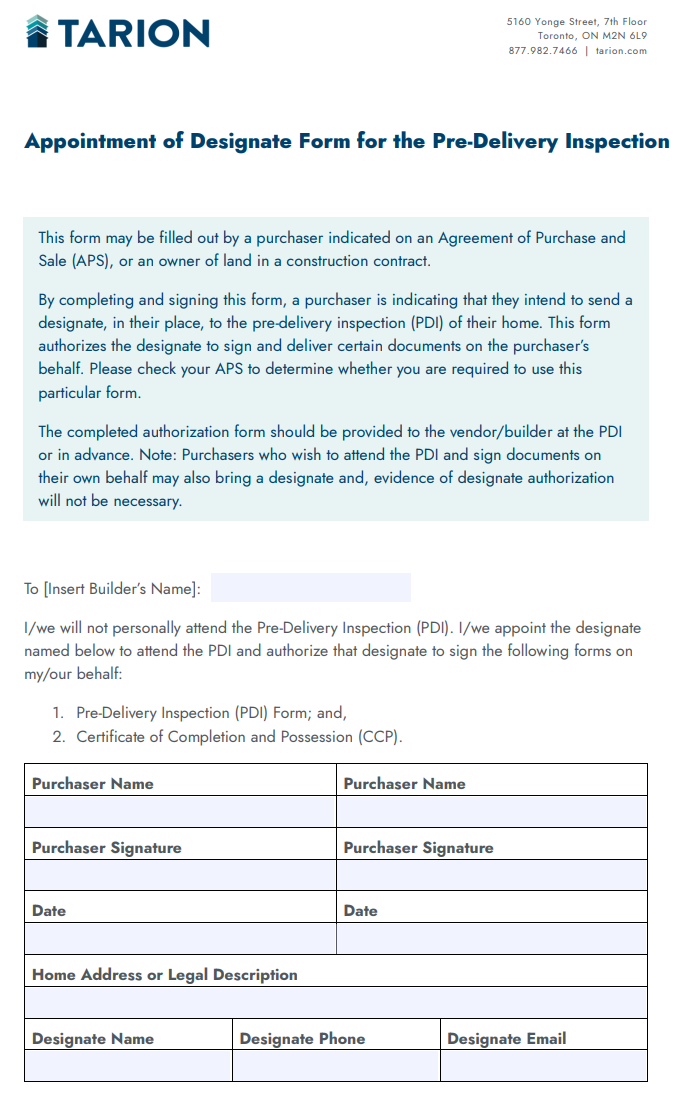
If you can’t attend, Tarion’s Appointment of Designate Form lets you name someone to go in your place. Signing it authorizes your designate to sign two documents on your behalf: the PDI Form and the CCP. The form goes to the builder at the PDI or before it, and Tarion tells buyers to check their purchase agreement to see whether the builder requires that specific form.
What a good designate actually does
A builder representative walks the unit and writes items onto the form. The designate’s job is to make sure the list is complete and the wording holds up later. On a typical new stacked townhome walkthrough, the items we write up fall into a few groups:
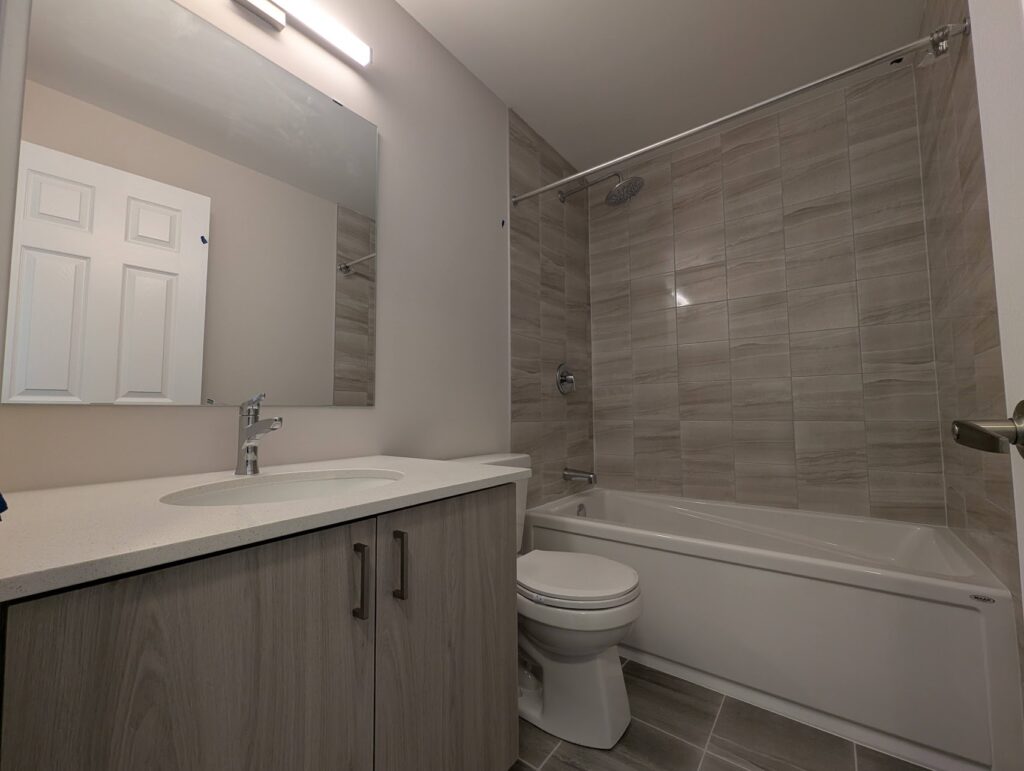
- Things that don’t operate properly: closet doors that bind, drawers that don’t slide smoothly, door locks, faucets, exhaust fans.
- Unfinished work: drywall patches left unpainted, rough corners, visible cut lines, a range hood fan not yet attached.
- Paint where it shouldn’t be: on tile or outlet covers.
- Noise and fit: squeaky stair nosing, ceiling fixtures not sitting flush.
Each item needs a precise location (“bottom of the basement stairs, right side,” not “basement”). We photograph every item and send the owner the full set the same day. The PDI form also has a section for anything that can’t be assessed, such as an air conditioner on a cold day. Use it. An item listed there is on the record even though nobody could test it.
Builders sometimes offer options at the PDI, such as leaving bathroom accessories in a cabinet for the owner to install instead of mounting them. In a rental, decide in advance who installs them and when. Otherwise they sit in a vanity until a tenant asks where the towel bar is.
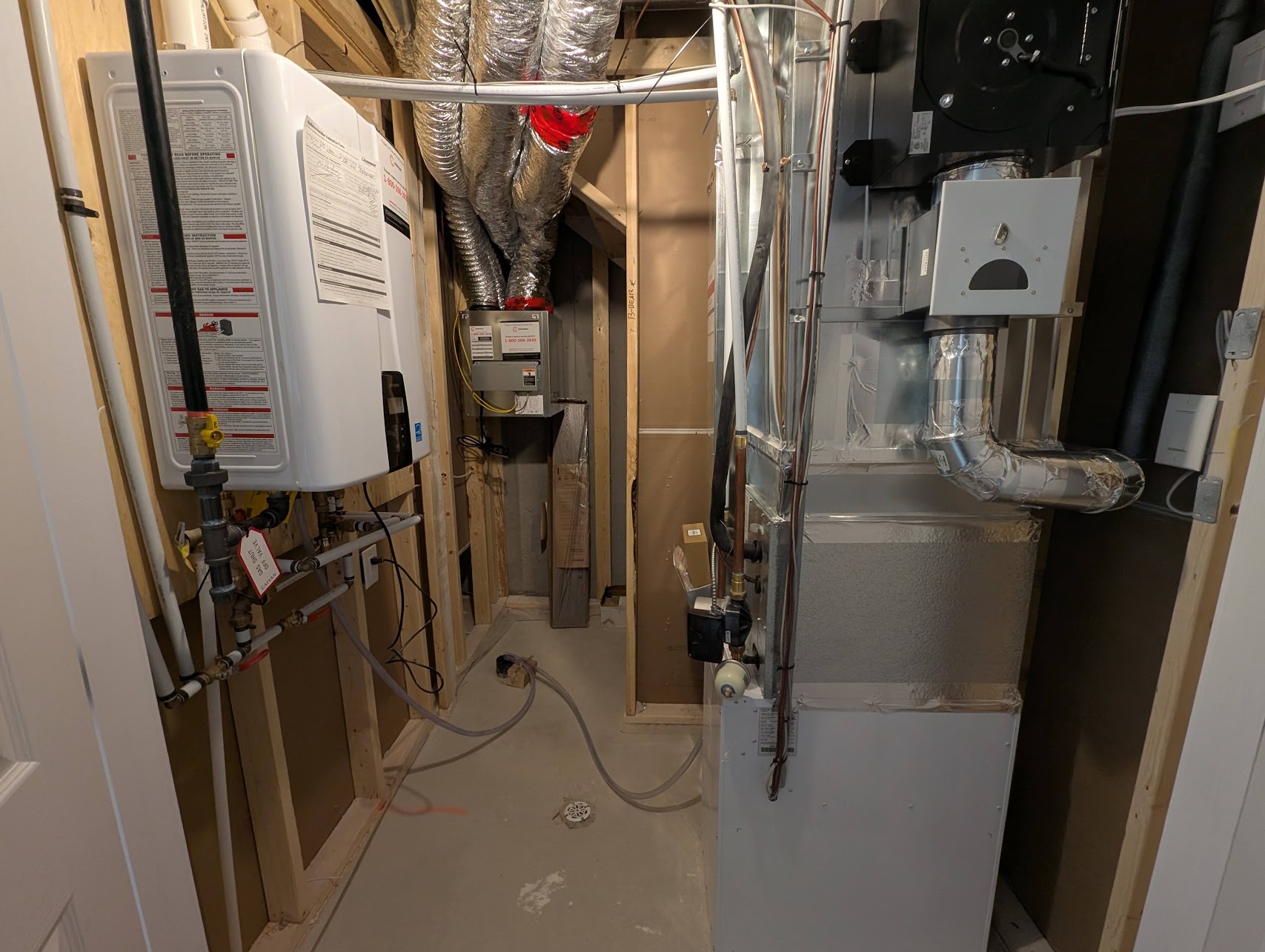
The designate also gets the builder’s walkthrough of the ventilation and heating systems. That’s the information your tenant will need on move-in day, and it’s the one part of the PDI you can’t get from a form.
Getting PDI Items Fixed in a Unit You Can’t Visit
After occupancy, the builder’s service team takes over from the sales and design staff. Caivan, for example, hands owners to a dedicated Orléans Village service team that books and manages warranty repairs.
Two things trip up remote owners here.
First, the paperwork. Caivan’s handover sheet tells owners that any outstanding PDI items, plus new issues found after move-in, should go on the Tarion Initial Form. Being on the PDI form isn’t enough on its own. Tarion recommends registering for MyHome as soon as you take possession, using the enrolment number on your CCP, so the submission reaches the builder and Tarion at the same time.
Second, access. Builders need to get into the unit to make repairs, and Tarion lists giving reasonable access as one of the homeowner’s responsibilities. Every trade visit needs someone to let them in, confirm the work and photograph the result before the item is closed off.
Timing is the reason this matters for a rental. Before a tenant moves in, the owner or manager can schedule trades freely. After move-in, Ontario’s Residential Tenancies Act requires written notice of at least 24 hours for most entries, between 8 a.m. and 8 p.m. Every return visit by a drywall or paint crew becomes a notice, a coordination problem and an imposition on your tenant. Clearing the PDI list before move-in is cheaper for everyone.
Making the Unit Rent-Ready
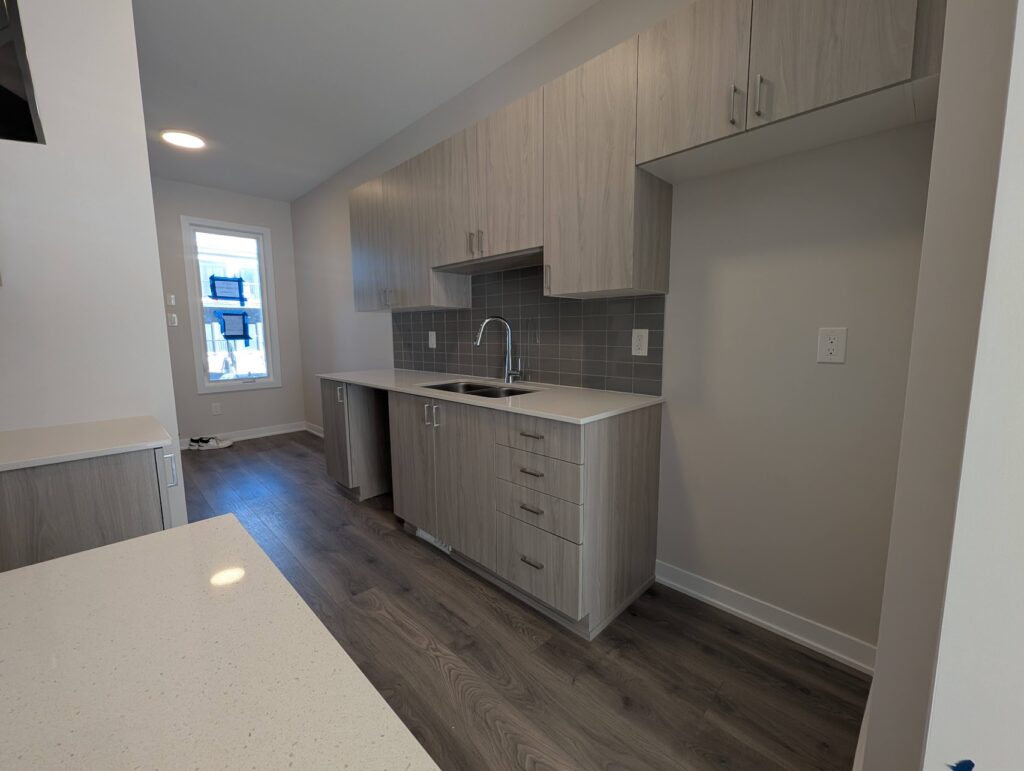
Appliances
Be on site for delivery. Check every appliance for dents and confirm it’s installed and working, since standard packages can’t be exchanged once delivered. Record model and serial numbers and register manufacturer warranties in the owner’s name.
Blinds
This is the item owners forget most often. Tenants won’t move into a unit without window coverings, and listing photos of bare windows rent slower. We measure and order at the start. The blinds go up before the listing photos are taken.
Garage door openers
In townhome-style units with a garage, the opener often isn’t part of the standard package. Check your agreement. If it’s missing, we coordinate the installation, program the remotes and record how many remotes the tenant receives on the move-in report.
Utilities and rented equipment
Accounts go in the owner’s name until the lease starts, then transfer according to the lease. Rented equipment, like a tankless water heater or air handler, carries a monthly charge that many investor spreadsheets leave out. Decide before you list whether the owner or the tenant pays it, and write it into the lease.
Mailbox key
Activate and pick up the key through Canada Post before move-in, so the tenant doesn’t start with a mail problem.
The Builder’s PDI Isn’t Your Move-In Inspection
Here’s the distinction that costs landlords money. The builder’s PDI documents what the builder owes you. It says nothing about what a future tenant owes you.
Ontario landlords can’t collect a damage deposit. The only deposit the Residential Tenancies Act allows is a rent deposit, usually last month’s rent, plus a refundable key deposit. If something is damaged when the tenant moves out, your evidence is the condition of the unit when they moved in. That’s it.
So once the deficiencies are fixed and before the tenant arrives, we produce our own pre-tenancy report: dated photos room by room, appliance condition, keys, fobs, garage remotes and the mailbox key handed over, and meter readings. The tenant reviews and signs it at move-in. We keep the open warranty items in a separate log so a builder defect never gets confused with tenant damage, in either direction.
Lease Terms Have to Match Your Insurance and Condo Rules
A rental condo unit needs a landlord’s unit-owner policy, and these policies often come with conditions that out-of-town owners never read. Conditions we’ve seen on binders for new-build rental units include a minimum lease term of one year, no short-term rentals, no student rentals and a minimum occupancy level for the building. Rent the unit in a way that breaks a condition and you may have a claim problem when you can least afford one. Read the conditions on your binder before the listing goes live.
Ontario’s Condominium Act also requires an owner who leases a unit to notify the condominium corporation, within 10 days of entering into the lease, and provide a copy of the lease or a summary of it. The tenant is bound by the declaration, by-laws and rules, so give the tenant a copy.
If the unit is still in interim occupancy, check whether your purchase agreement allows leasing before final closing. Tarion’s guidance doesn’t address it, and some agreements restrict it. Ask your real estate lawyer before you sign a lease.
Non-Resident Owners Have One More Job
If you’re a non-resident of Canada for tax purposes, the Canada Revenue Agency requires 25% tax to be withheld from the gross rent, unless an approved NR6 undertaking lets withholding be calculated on net rental income instead. The tenant or the agent collecting the rent, usually the property manager, is responsible for withholding and remitting it. Set this up with your accountant before the first rent cheque, not after.
The Fair Case: When You Don’t Need a Property Manager for This
None of this is hidden. Builders like Caivan hand buyers a clear next-steps sheet with utility contacts and service team details. Tarion publishes plain-language guides and runs the MyHome portal. Tarion also backs the builder’s warranty with coverage limits: up to $300,000 for work and materials, up to $20,000 for a condominium deposit and up to $7,500 for delayed closing, according to its condominium guide.
If you have a reliable relative in Ottawa with flexible weekdays, they can be your PDI designate, wait for the lockbox code and let in the appliance crew. Many owners do it that way and it works.
Where it falls apart is judgment and availability over several weeks. Knowing which items to push for at the PDI, which go on the Initial Form, which belong to the condo corporation and which trade visit to chase. Being on site at short notice, more than once. That’s where a manager earns the fee.
What to Hand Off, by Owner Type
| Owner type | Hand off | Keep doing yourself |
|---|---|---|
| Out-of-province investor | PDI as designate, deficiency follow-up, rent-ready work, tenant placement | MyHome account, insurance, approving lease terms |
| Overseas non-resident | Everything on site, plus rent collection with non-resident withholding | NR6 filing and annual return with your accountant |
| Owner moving in within a few years | PDI and the pre-tenancy report, so warranty items and tenant wear stay separate | Year-End and Second-Year forms, which you’ll want to file as the future occupant |
| First-time investor | Lease drafting, condo notice, the move-in report | Reading your APS for inclusions before the PDI, so you know what’s missing |
What This Guide Can’t Tell You
- The worked example is one builder’s handover process. Other Ottawa builders handle key release and appliance delivery differently.
- Inclusions like openers and appliance packages are set by your agreement of purchase and sale, not by this guide.
- Tarion’s form names and deadlines have changed before and may change again. The dates in your MyHome account are the ones that count.
- Timing estimates (weeks to rent-ready, blind lead times) come from our own experience on new-build handovers. They aren’t measured market data.
- Insurance conditions vary by insurer and policy. Tax treatment depends on your residency, which is a question for your accountant.
The Bottom Line
Out-of-town buyers think of property management as finding a tenant. On a new build, the bigger risk sits before that: a 41-day warranty window that starts at possession, a PDI list that only protects you if it’s complete and a unit that closes without blinds or installed appliances.
Get those weeks right and the first lease starts on a clean record. Get them wrong and you’re chasing deficiencies through a tenant’s door, with 24 hours’ notice each time.
Frequently Asked Questions
Can someone else do my Tarion pre-delivery inspection for me?
Yes. Tarion’s Appointment of Designate Form lets you name a designate to attend the PDI and sign the PDI Form and the Certificate of Completion and Possession on your behalf. Give it to the builder at or before the PDI, and check your purchase agreement to see whether the builder requires that form.
When does the Tarion warranty start on a new condo townhome?
On the warranty start date shown on your Certificate of Completion and Possession. For condominium units with interim occupancy, Tarion says the warranty starts when interim occupancy begins, not when you move in or when title transfers.
What is the deadline for the Tarion Initial Form?
Tarion says you can submit the Initial Form between 1 and 41 days after your warranty start date. Use it for items left outstanding from the PDI and anything new you find. Confirm the exact dates in your MyHome account.
Who fixes PDI items after closing?
The builder. After occupancy, the builder’s service team schedules repairs, and you need to give the trades reasonable access. If the builder doesn’t resolve a warranted item, Tarion can step in once you’ve filed the right form on time.
Are blinds and garage door openers included in Ottawa new builds?
Often not. Blinds are rarely in a standard package, and openers are frequently left out of townhome-style units with garages. Check your agreement of purchase and sale, and plan both before your rent-ready date.
Can I rent out my new condo during interim occupancy?
It depends on your purchase agreement. Tarion’s guidance on interim occupancy doesn’t address leasing, and some agreements restrict it before final closing. Ask your real estate lawyer before signing a lease.
Do I need a move-in inspection if the builder already did a PDI?
Yes. The PDI documents what the builder owes you. Ontario landlords can’t collect a damage deposit, so a signed, photo-backed move-in report is your evidence of the unit’s condition when the tenant took possession.
Closing on an Ottawa New Build From Out of Town?
We attend the PDI as your designate, photograph every item and follow the builder’s service team until the list is closed. Then we wait for the appliances, get the blinds and opener installed and produce a signed move-in report before your tenant gets the keys.
Tell us your closing date and we’ll map the weeks from PDI to first lease, with what we handle and what stays with you.
613-800-2523 · info@rentsetgo.ca
BOOK A CALL GET A FREE MANAGEMENT QUOTE
Managing rentals for local and out-of-town owners across Ottawa, including new-build communities in Orléans.
Related Reading
- Tarion: How to make a warranty claim and what to expect
- Tarion: The Initial Form and your first warranty claim
- Tarion: Interim occupancy for new condominium buyers
- Register for Tarion MyHome
This article is general information, not legal or tax advice, and not insurance advice. Warranty details are drawn from Tarion’s published guidance and its condominium warranty guide, current as of October 2026. Builder process details are based on one Ottawa builder’s standard handover documents and will differ between builders and projects. Timing estimates reflect RentSetGo’s own experience, not measured data. Tarion forms and deadlines, Residential Tenancies Act and Condominium Act requirements, and CRA non-resident rules can change. Confirm your dates in Tarion MyHome and get advice from your lawyer and accountant before acting.