
Ottawa issued 1,354 permits for secondary and additional dwelling units between January 2023 and September 2026, and those permits added 2,237 dwelling units. The pace is still climbing. Suite permits rose from 269 in 2023 to 364 in 2024 and 409 in 2025, and the first nine months of 2026 produced another 312 permits and 569 units. In 2025, suites made up 7.79 percent of every net new home the city permitted, roughly 1 in 13. RentSetGo Property Management builds this page from the City of Ottawa’s open building permit files, retrieved October 25, 2026, and refreshes it as the City publishes new files.
This page is the numbers companion to our guide to adding secondary dwelling units in Ottawa, which covers what your lot allows and how the permit process runs. Citywide supply, apartments and subdivisions included, sits on our Ottawa housing pipeline page. The front end of that supply, the applications entering the planning system, is tracked on our Ottawa development applications page. Here the lens is narrower: the suites going into and beside ordinary houses, ward by ward and type by type. Those units compete head-to-head with basement apartments and duplexes, and a suite is the one kind of supply a house owner can add without buying another property.</p> <h2>How many secondary suites is Ottawa permitting each year?</h2> <p>More every year, and 2026 is tracking 2025 rather than falling back. The nine months to September 2026 averaged 34.7 suite permits a month, a touch above the 34.1 a month recorded across 2025, and units per month rose from 60.2 to 63.2. Extended across a full year at that pace, 2026 would land near 416 permits and 759 units. That is arithmetic on nine months of data, not a forecast, and permit issuance has seasonal swings. What the completed years show is simpler: the count has grown for three straight years, and the suite share of all net new homes permitted has grown with it, from 4.75 percent in 2023 to 7.79 percent in 2025.</p> <table style=” width:100%;=”” border-collapse:collapse;=”” margin:28px=”” 0;=”” font-family:nunito,=”” inter,=”” ‘segoe=”” ui’,=”” roboto,=”” arial,=”” sans-serif;=”” font-size:16px;”=””> Period Suite permits Suite units added All net new units permitted Suite share 2023 269 377 7,936 4.75% 2024 364 568 10,356 5.48% 2025 409 723 9,282 7.79% 2026, January to September 312 569 7,828 7.27% January 2023 to September 2026 1,354 2,237 – –
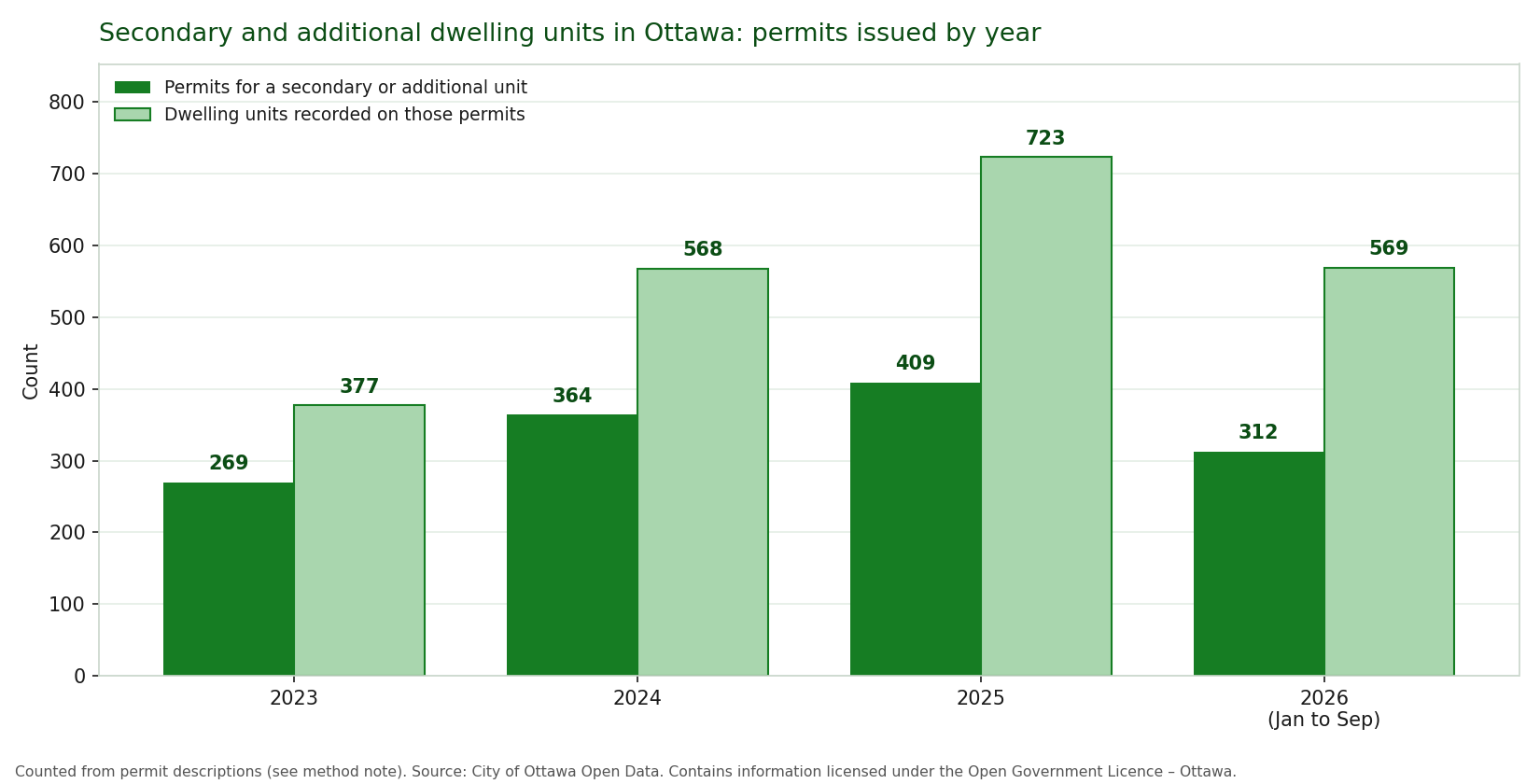
Secondary suite permits and units added, 2023 to September 2026. Counts are built from permit description text; the method is set out below. Source: City of Ottawa Open Data, Construction, Demolition, and Pool Permits workbooks, retrieved October 25, 2026.
Where are Ottawa’s secondary suites being added?
College ward, in the city’s west end, leads Ottawa in both periods this page covers: 37 suite permits in 2025 and 30 more in the first nine months of 2026. The rest of the top of the table mixes established inner wards with fast-growing suburbs. Alta Vista, Kitchissippi and Rideau-Rockcliffe sit near the top in both years. So do Stittsville and Orléans South-Navan, where new subdivisions are being built with suites designed in. Kitchissippi covers neighbourhoods such as Westboro and Hintonburg, the streets covered by our Westboro property management page, and its numbers need a second look, because permits and units tell different stories there. The demand side of those same wards is mapped on our Ottawa renters by ward page.
<h3>Top 10 wards for suite permits, 2025</h3> <table style=” width:100%;=”” border-collapse:collapse;=”” margin:28px=”” 0;=”” font-family:nunito,=”” inter,=”” ‘segoe=”” ui’,=”” roboto,=”” arial,=”” sans-serif;=”” font-size:16px;”=””> Ward Suite permits Suite units added Ward 8, College 37 50 Ward 6, Stittsville 30 35 Ward 15, Kitchissippi 26 86 Ward 18, Alta Vista 25 34 Ward 16, River 24 50 Ward 19, Orléans South-Navan 23 32 Ward 1, Orléans East-Cumberland 22 26 Ward 7, Bay 21 72 Ward 12, Rideau-Vanier 18 47 Ward 13, Rideau-Rockcliffe 15 57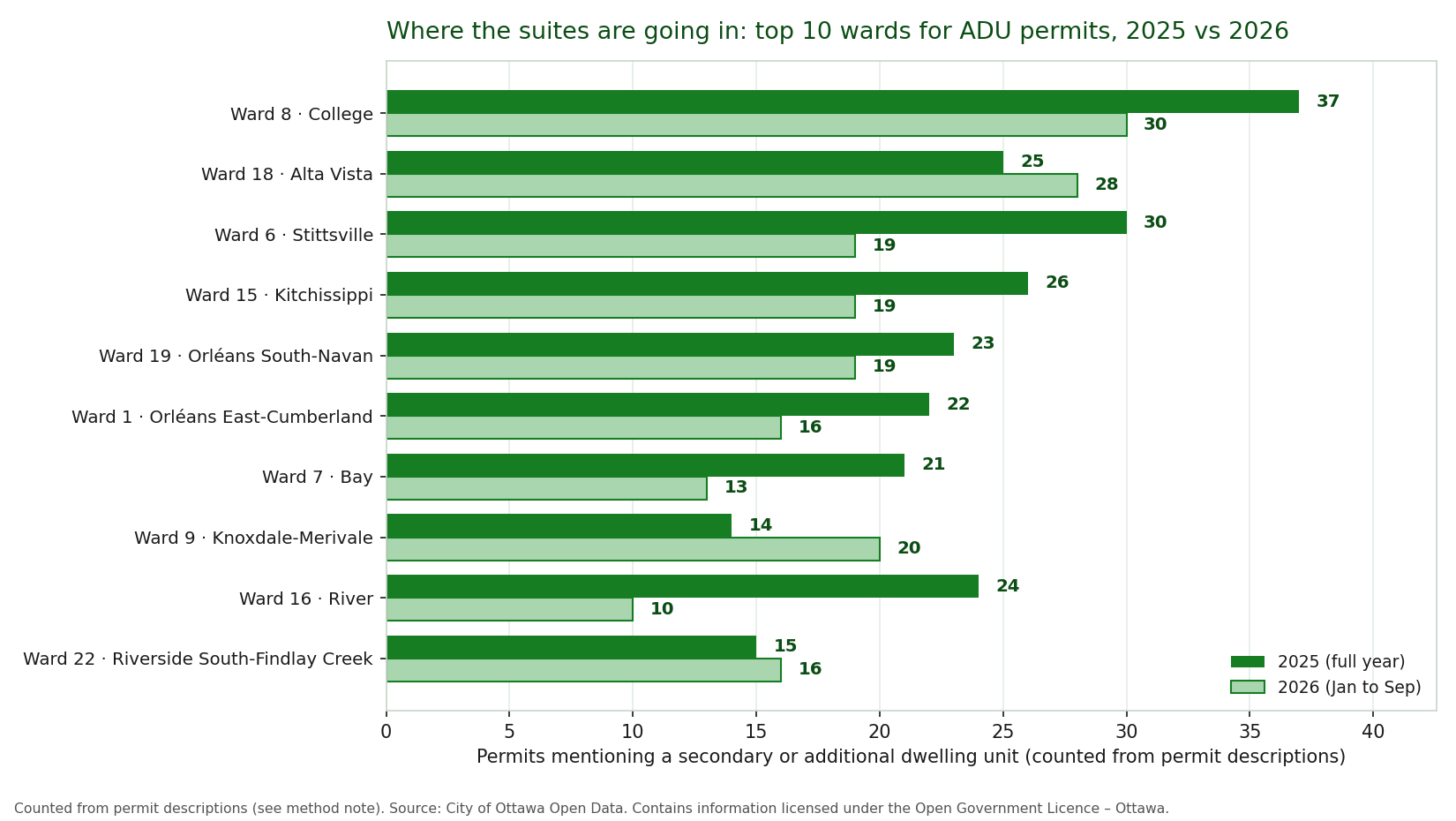
Top 10 wards for secondary suite permits, 2025 and January to September 2026. Source: City of Ottawa Open Data, Construction, Demolition, and Pool Permits workbooks, retrieved October 25, 2026.
Top 10 wards for suite permits, January to September 2026
| Ward | Suite permits | Suite units added |
|---|---|---|
| Ward 8, College | 30 | 46 |
| Ward 18, Alta Vista | 28 | 45 |
| Ward 9, Knoxdale-Merivale | 20 | 32 |
| Ward 15, Kitchissippi | 19 | 43 |
| Ward 19, Orléans South-Navan | 19 | 31 |
| Ward 6, Stittsville | 19 | 27 |
| Ward 1, Orléans East-Cumberland | 16 | 19 |
| Ward 22, Riverside South-Findlay Creek | 16 | 17 |
| Ward 3, Barrhaven West | 15 | 15 |
| Ward 13, Rideau-Rockcliffe | 14 | 26 |
Nine months into 2026 the order has barely shuffled. College still leads, Alta Vista is second, and Knoxdale-Merivale has moved into third with 20 permits. Somerset, the downtown ward, sits near the bottom of the full ward list in both periods, with 6 suite permits in 2025 and 5 more to September 2026. Its housing stock is apartment-led, with fewer houses standing on lots that can take a suite. Suite growth follows the house stock: it happens where houses with room to convert or rebuild actually stand.
What kinds of suites is Ottawa permitting?
Basement suites are the largest single group: 785 of the 1,354 permits since January 2023, adding 949 units. Coach houses, the detached suite in its own small building, are 101 permits and 95 units across the same period, running at a steady 22 to 33 permits a year. Neither group holds the most units. That distinction belongs to the permits whose text never says where the suite sits: 468 permits adding 1,193 units, 53 percent of all suite units counted, at 2.5 units per permit. A permit that names a unit without naming a basement, written for a new-build house, is usually one of several suites permitted together. That category is where the unit growth is concentrated.
| Suite type, from permit text | 2023 | 2024 | 2025 | 2026, Jan–Sep | Total permits | Total units |
|---|---|---|---|---|---|---|
| Basement suite | 192 | 218 | 223 | 152 | 785 | 949 |
| Other in-house suite (location not stated) | 54 | 113 | 163 | 138 | 468 | 1,193 |
| Coach house | 23 | 33 | 23 | 22 | 101 | 95 |
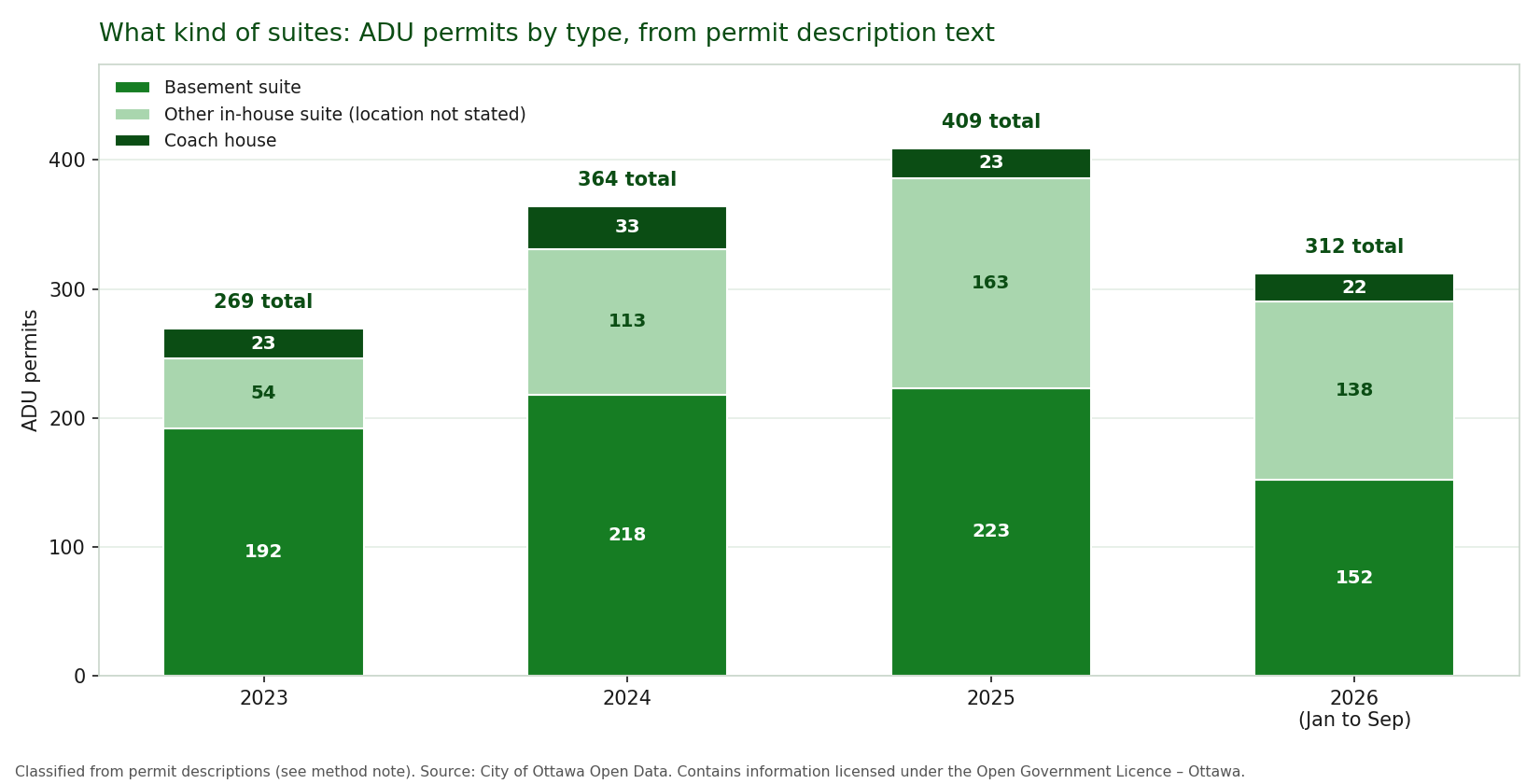
Secondary suite permits by type, read from permit description text, 2023 to September 2026. Source: City of Ottawa Open Data, Construction, Demolition, and Pool Permits workbooks, retrieved October 25, 2026.
One term never appears. Across every permit description the City published from 2023 to 2026, the words “garden suite” occur zero times. Landlords searching that phrase are using another market’s vocabulary. In Ottawa’s permit text, and in its zoning language, the detached form is a coach house, and anyone quoting an Ottawa garden-suite count has built it from something other than these files.
What this data can’t tell you
Three limits matter before anyone quotes these numbers. First, a permit issued is not a suite built, and a suite built is not a suite occupied. Permits lapse, projects stall, and the files carry no completion or occupancy record. Second, nothing in a permit says who will live in the suite. Some of these units will be rented at market rates. Others will house family members, and some may sit empty for a period. The rental-supply effect of 2,237 permitted units is real, but it is smaller than the raw count, and any exact rental figure built from this data would be invented rather than measured. Third, the count itself is a floor, not a ceiling. It is built from three phrases in permit description text, set out in the method section below, and suites described in other words are missed. We found 23 permits across 2023 to 2025 worded as variants, such as “secondary suite” or “accessory dwelling unit”, that the count deliberately excludes to stay consistent with its method. The true totals are modestly higher, on the order of 1 to 2 percent.
How we counted Ottawa’s secondary suites
The source is the City of Ottawa Open Data dataset Construction, Demolition, and Pool Permits: the annual file for 2023, the combined file for 2024 and 2025, and the monthly file for 2026, all retrieved October 25, 2026. The permit files carry no field that flags a secondary suite, so identification comes from the permit’s own description text. A permit is counted when its description contains “secondary dwelling”, “additional dwelling” or “coach house”, read case-insensitively, and records whose description starts with “Cancelled” are excluded.
Counting follows the files’ own layouts. In the 2023 file and the first part of 2024, one permit repeats across several address rows with its unit total repeated, so those permits are counted once per permit number. In the newer monthly files each row carries its own units, so units are summed across matched rows and permits are the distinct permit numbers. Every column is read by name, never by position. The type split applies a second pass over the same text: “coach house” first, then “basement”, then everything else as an in-house suite whose location the text does not state. The two named terms never appear on the same permit, so the classes cannot overlap. Units are the permit files’ own net dwelling unit figures, taken as recorded. 56 of the matched permits record zero net units, most of them revisions, and they are counted as permits with zero units rather than dropped. The ward tables use the 2022 to 2026 ward boundaries in the source files, and every ward row sums exactly to its period total.
Shares are computed inside the same files: the suite share for a period divides suite units by all net new units in the same permit files. One caution follows from that. The City’s separate Housing Approvals series puts 2025 net permits at 9,561 rather than the 9,282 in these workbooks, and on that denominator the 2025 suite share would be 7.56 percent instead of 7.79 percent. Either way, the reading is the same: about one suite in every 13 new homes. Contains information licensed under the Open Government Licence – Ottawa.
What This Means if You Own a Rental in Ottawa
The figures above are measurements. What follows is our reading of them for Ottawa landlords, labelled as interpretation throughout.
Suites are now a standing supply channel
A supply channel that permitted 723 units in 2025, and 569 more in the first nine months of 2026, behaves differently from a tower completing all at once. There is no single lease-up season to plan around. Instead, the stock of legal suites in established neighbourhoods thickens a little every quarter: 2,237 units in 45 months. If you rent out a basement apartment or a duplex unit, this is your direct competition, and it is arriving steadily rather than in waves.
The growth is new-build product
The fastest unit growth sits in the category nobody pictures: houses permitted with their suites already designed in. That group averages 2.5 units per permit, and it drove Kitchissippi to 86 units on 26 permits in 2025. Builders have learned that a house which can legally hold three households sells and rents differently from one that holds one. Owners shopping for a new build as a rental should read the permit, not the listing sheet, to see how many legal units the house actually carries.
Coach houses get the attention; in-house suites do the work
Coach houses anchor the magazine features, and they are 101 permits in 45 months. The other 1,253 permits are suites inside houses. An owner weighing a coach house against a basement conversion is weighing the most expensive, slowest route to one unit against the route most of the city is taking to one or two. The design and zoning rules differ by route, and the rules guide linked at the top of this page walks through both.
The map is inner wards plus suite-ready suburbs
College, Alta Vista, Kitchissippi and Rideau-Rockcliffe lead on permits, with Stittsville and Orléans South-Navan close behind. If you own a rental in one of those wards, assume new legal suites are appearing on nearby streets every year, and price renewals with that in mind. If your property sits in a ward near the bottom of the table, suite competition is thinner, and your competing supply is more likely to come from the apartment pipeline than from the house next door.
If you are weighing a suite of your own
Every permit in these tables is an owner who ran the same calculation: construction cost and hassle against a second rent from a property they already own. The data cannot run that calculation for your house. What settles it is the rent the suite would actually achieve on your street, priced against the main home’s rent, and that is an appraisal question rather than a data question. Price both units before you commit to drawings.
When this is a watch item, not an action item
Plenty of landlords can reasonably do nothing with this page. If your property is tenanted on a stable lease in a ward adding few suites, the trend is background. Where it starts to bite is at a decision point: a purchase, a renovation, a unit coming empty in a ward where suites and new builds are both landing. That is where our property management service earns its fee, pricing and leasing units against the local supply picture instead of the city average.
The Bottom Line
Ottawa’s secondary suites have moved from exception to channel. Permits climbed from 269 in 2023 to 409 in 2025, the 2025 permits alone added 723 units, and suites now account for about 1 in every 13 net new homes the city permits. Most of that growth is inside houses, increasingly inside new houses built with several suites at once, and it concentrates in a handful of inner and suburban wards led by College. None of these figures prices a suite or settles whether your lot should carry one. They do tell you the direction of small-scale supply on the streets where basement apartments and duplexes rent, and that direction has not reversed in four years of files. This page is refreshed as the City publishes new permit files; the figures above are the October 25, 2026 retrieval.
Frequently Asked Questions
How many secondary suites were permitted in Ottawa in 2025?
409 permits, adding 723 units. Those units were 7.79 percent of the 9,282 net new dwellings in the City of Ottawa’s permit files for 2025, retrieved October 25, 2026.
What share of Ottawa’s new homes are secondary suites?
7.79 percent of net new dwellings permitted in 2025, about 1 in 13, up from 4.75 percent in 2023. In the first nine months of 2026 the share was 7.27 percent. The share is computed inside the City’s permit files; the City’s separate Housing Approvals series would put the 2025 share at 7.56 percent.
Which Ottawa ward is adding the most secondary suites?
College ward (Ward 8) leads on permits in both periods covered: 37 permits in 2025 and 30 in the first nine months of 2026. Kitchissippi ward (Ward 15) added the most units in 2025, 86 units on 26 permits, because many of its permits cover new houses built with several suites at once.
Are basement suites or coach houses more common in Ottawa?
Basement suites, by a wide margin: 785 permits from January 2023 to September 2026, against 101 coach house permits. A third group, in-house suites whose permit text does not state a location, accounts for 468 permits but the most units, 1,193.
Why are there no garden suite numbers for Ottawa?
The words “garden suite” appear in zero Ottawa permit descriptions from 2023 to 2026. In the City of Ottawa’s permit text and zoning language, the detached suite on a house lot is called a coach house, and it is counted under that name on this page.
Does a secondary suite permit mean the suite is rented out?
No. A permit records permission to build a unit. The permit files carry no completion, occupancy or tenure information, so this page counts permitted units only. Some suites house family members, and some permitted suites may never be built.
How often is this page updated?
As the City of Ottawa publishes new permit files. This edition covers January 2023 to September 2026 and uses files retrieved October 25, 2026.
Thinking of Adding a Suite, or Already Renting One Out?
RentSetGo Property Management manages houses with secondary suites across Ottawa. We price the main home and the suite as one property, screen and lease both units, then handle the maintenance calls and questions from two households under one roof.
Send us the address of a house you own or are assessing. We will return a free rental appraisal covering the property as it stands and, where a suite is in place or permitted, what the suite does to the rent picture.
613-800-2523 · info@rentsetgo.ca
BOOK A CALL GET A FREE RENTAL APPRAISAL
Managing rentals for local, out-of-province and non-resident owners across Ottawa, including suite-heavy wards such as College, Kitchissippi and Alta Vista.
Related Reading
- Adding Secondary Dwelling Units in Ottawa
- Ottawa Housing Pipeline: What’s Being Built, and Where
- How Much Rent Can You Charge in Ottawa? A 2026 Market Guide for Landlords
- Westboro Property Management
- City of Ottawa: Adding a Coach House (Additional Dwelling Units in an Accessory Structure) (official source)
- Ottawa Renters by Ward: Where the City’s Renters Live
- Ottawa Development Applications: The Front End of the Housing Pipeline
Data: City of Ottawa Open Data, Construction, Demolition, and Pool Permits workbooks (2023 file; 2024 to 2025 file; 2026 file), retrieved October 25, 2026; contains information licensed under the Open Government Licence – Ottawa. Suite counts are built from permit description text and are approximate: suites described in other wording are missed, so the true counts are modestly higher. A building permit authorizes construction; it does not confirm that a suite was built, occupied or rented, and the source files carry no tenure information. The 2025 suite share is computed within the permit workbooks; the City’s Housing Approvals series reports a different 2025 permits total (9,561 against 9,282), which would put the share at 7.56 percent. Figures change as the City revises its files. This page is general information about Ottawa housing supply, not legal, tax, insurance or investment advice. Consult a licensed paralegal or lawyer, an accountant, or an insurance broker for advice on your own property.